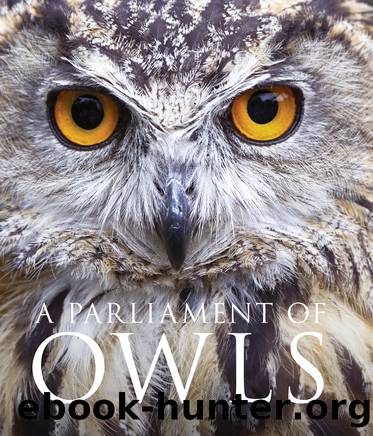
A Parliament of Owls by Mike Unwin & David Tipling
Author:Mike Unwin & David Tipling
Language: eng
Format: epub
Publisher: HarperCollinsPublishers
Published: 2016-10-09T16:00:00+00:00
By average weight, Blakiston’s Fish Owl is the largest owl in the world.
BLAKISTON’S FISH OWL
BUBO BLAKISTONI (KETUPA BLAKISTONI)
APPEARANCE
Very large; tousled, sideways-projecting ear tufts; facial disk tawny, with indistinct rim and pale cross at center; eyes yellow and bill grayish; upper parts brown, with fine blackish-brown stripes; mantle paler and more rufous, with dark bars and streaks; under parts buffish-brown with dark vertical streaks; broad, long wings barred with buff; dark tail barred in cream-yellow; legs feathered down to feet.
SIZE
length 24 – 28 in. (60 – 72 cm)
weight 6.5 – 10.1 lb (2.95 – 4.6 kg)
wingspan 70 – 75 in. (178–190 cm)
DISTRIBUTION
Eastern Russia, from Amur and Ussuri river basins to Okhotsk Coast, Sakhalin, Lake Khanka, and south of Vladivostok; west Manchuria and Heilongjiang, China; Hokkaido Island, Japan, and Kuriles.
STATUS
Endangered
ANY FISHERMAN WILL TELL YOU that good things come to those who wait. And this huge owl—on average, the world’s largest—follows this maxim with great dedication. Perched beside an icy stream in the cold night, feathers fluffed against the falling snow, it may sit for hours on end to get its reward.
The title of world’s largest owl has two main contenders: this species and the Eurasian Eagle Owl. Both boast the same highest recorded weight: a hefty, cat-size 10.1 pounds (4.6 kg). However, only one race of Eurasian Eagle Owl—the easternmost Russian subspecies, which shares the range of Blakiston’s Fish Owl—grows this large, so the species’ average weight falls below that of the fish owl.
In addition to its size, the first thing you will notice about Blakiston’s Fish Owl is its drooping, tousled ear tufts, which project horizontally to create a silhouette that immediately distinguishes it from the Eagle Owl. Seen in good light, its plumage is also more tawny-yellow overall. Unusual in a fish-catching owl, the tarsi are feathered right down to the feet, and the feet themselves are enormous, with long talons and rough scales to help grasp slippery, struggling fish.
Blakiston’s Fish Owl gets its name from English naturalist Thomas Blakiston, who collected the original specimen on Hokkaido Island in Japan in 1883. It is also known as Blakiston’s Eagle Owl, which is arguably more correct, because this species is very closely related to eagle owls—whose genus Bubo it shares—and is thought by some scientists to represent an evolutionary link between fish owls and eagle owls. In fact, all four Asian fish owl species are now grouped along with eagle owls in Bubo, having formerly made up their own genus Ketupa. Scientists today divide Blakiston’s Fish Owl into two subspecies: the nominate race B. b. blakistoni is found in Japan; the slightly larger race B. b. doerriesi inhabits the Russian mainland and differs by its call.
Throughout its range, Blakiston’s Fish Owl needs dense forest near flowing waterways, typically on wide river plains. The forest types vary from coniferous (including dense fir and spruce forest on the Kuriles) to mixed and broad-leaved, but whatever the forest, it must have cavernous old-growth trees for breeding. The waterways—rivers, streams, or river mouths—should remain at
Download
This site does not store any files on its server. We only index and link to content provided by other sites. Please contact the content providers to delete copyright contents if any and email us, we'll remove relevant links or contents immediately.
Shoot Sexy by Ryan Armbrust(17733)
Portrait Mastery in Black & White: Learn the Signature Style of a Legendary Photographer by Tim Kelly(17008)
Adobe Camera Raw For Digital Photographers Only by Rob Sheppard(16982)
Photographically Speaking: A Deeper Look at Creating Stronger Images (Eva Spring's Library) by David duChemin(16691)
Bombshells: Glamour Girls of a Lifetime by Sullivan Steve(14081)
Art Nude Photography Explained: How to Photograph and Understand Great Art Nude Images by Simon Walden(13052)
Perfect Rhythm by Jae(5410)
Pillow Thoughts by Courtney Peppernell(4287)
The Book of Joy by Dalai Lama(3995)
Good by S. Walden(3564)
The Pixar Touch by David A. Price(3444)
A Dictionary of Sociology by Unknown(3088)
Fantastic Beasts: The Crimes of Grindelwald by J. K. Rowling(3061)
Stacked Decks by The Rotenberg Collection(2885)
Humans of New York by Brandon Stanton(2876)
Read This If You Want to Take Great Photographs by Carroll Henry(2713)
On Photography by Susan Sontag(2643)
Insomniac City by Bill Hayes(2561)
Photographic Guide to the Birds of Indonesia by Strange Morten;(2538)
